
I would ask GPT to compare vendor proposals against requirements I had already written down, with a source reference beside each important claim. I would calculate comparable costs separately and keep unanswered questions visible. The resulting matrix should make a purchasing discussion clearer; it should not manufacture a winner from incomplete offers.
That is how I would compare vendor proposals with ChatGPT for a small operational purchase. A polished proposal can describe a different service from its competitor, even when both use the same reassuring headings. Summarizing each document independently does not reveal that mismatch.
The printer-service example below uses invented prices and conditions to show the method. It is not an account of a purchase I made or a performance test of a model.
Write the purchase requirement before opening the scores
Suppose a small office needs a printer-service agreement. I would first state the required volume, service location, support coverage, start conditions, and any nonnegotiable restrictions. Someone with authority over the purchase would need to confirm those requirements.
I would distinguish mandatory requirements from preferences. A requirement that the supplier service our location is different from a preference for a shorter response time. An attractive price cannot compensate for a supplier who does not cover the site.
For this example, assume the office expects 2,000 pages a month and needs on-site service at its address. I would not ask the model to infer either fact from the office's size or the names of the vendors.
I would also define the comparison period as one year and record what the cost calculation excludes. That keeps a monthly headline, an annual charge, and an installation fee from being compared as if they were equivalent.
Only then would I bring the permitted proposals into the workflow. The proposal files need names and versions so a reviewer can find the exact wording behind the comparison.
Extract the offer before evaluating it
I would consider GPT-6 Astra for comparing several interdependent terms, if it is available. Its documented positioning makes it a candidate for demanding analysis, not a substitute for proposal evaluation by the buyer. I would keep the source documents open beside the output. Official model documentation.
My first request would be extraction, not scoring:
Compare these proposals against the supplied requirements.
For each criterion, give the exact offered condition, source location,
and status: stated, conditional, absent, or conflicting.
Do not treat silence as inclusion or assume a missing charge is zero.
Do not choose a winner or invent ratings.
Keep vendor claims separate from independently verified facts.
List clarification questions that could change eligibility or cost.
For the constructed proposals, imagine the documents say the following:
Criterion | Offer A | Offer B |
|---|---|---|
Monthly fee | $100 | $120 |
Included monthly pages | 1,000 | 2,000 |
Extra pages | $0.05 each | $0.04 each |
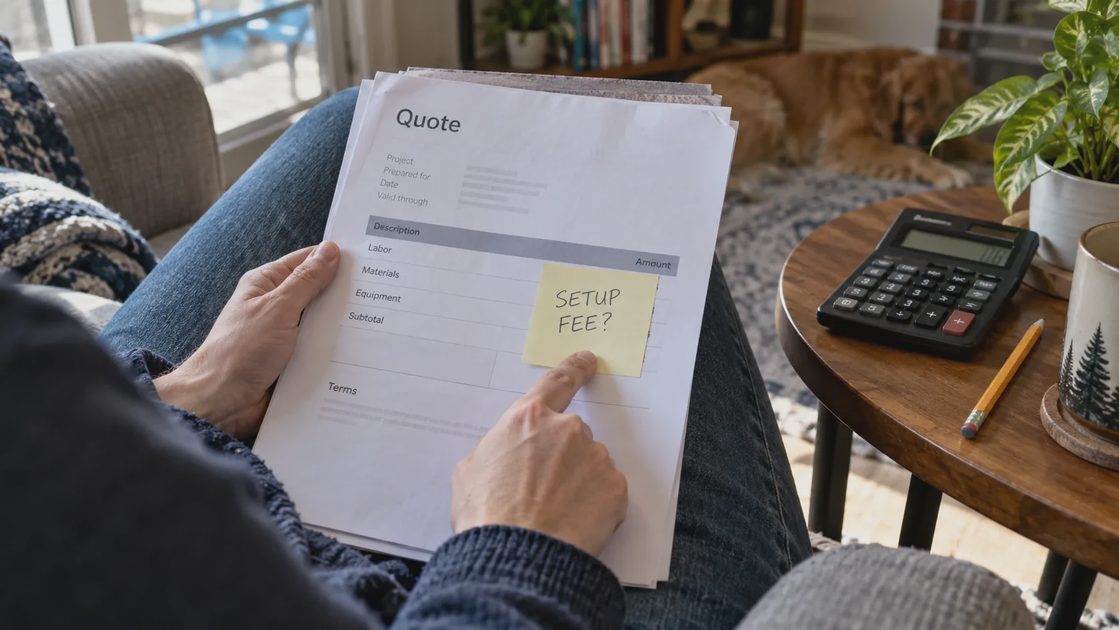
Setup charge | $200 | Not stated |
Site coverage | Listed as included | Subject to address confirmation |
In an actual vendor comparison matrix, I would attach the proposal page or section to every cell. These example values are invented inputs, so there are no genuine vendor source references to attach here.
I would inspect short terms especially closely. “Included” might apply to one service tier, and a response target might start only after remote troubleshooting. I would preserve the condition with the claim instead of shortening both into “good support.”
Calculate one common scenario, then change it
At the assumed 2,000 pages per month, Offer A would incur 1,000 extra pages monthly. The hypothetical first-year calculation is $100 × 12, plus 1,000 × $0.05 × 12, plus $200 setup: $2,000.
Offer B's stated monthly fee would total $120 × 12, or $1,440 before any unstated setup charge. I would not label that its complete annual price. The proposal has not supplied enough information to do so.
Those figures also assume the quoted charges apply throughout the year and exclude taxes and anything not specified in the example. A real total cost comparison would need the applicable terms checked rather than copied from this arithmetic.
Now change the assumed volume to 1,000 pages monthly. Offer A becomes $1,400 in the first year, including its stated setup charge. Offer B remains $1,440 before the unresolved setup charge. The apparent cost preference changes because the requirement changed, not because the model became more persuasive.
I would use that sensitivity check to ask a practical question: how confident are we in the volume assumption? If usage fluctuates, I would compare plausible supplied scenarios instead of averaging away the uncertainty.
I would calculate the numbers with a spreadsheet or calculator and inspect the formulas. Having GPT describe a calculation is different from verifying that the calculation matches the quoted units and conditions.
I would also check the unit of the allowance. A monthly allowance cannot be treated as an annual pool unless the offer permits unused capacity to carry forward. If the office prints heavily in one month and lightly in another, the same annual volume could produce a different charge. That question belongs beside the calculation, not hidden in a general risk paragraph.
I would keep the first-year view separate from the ongoing view. Offer A's stated setup charge appears once under this example's assumptions; multiplying that fee into every year would distort the comparison. Conversely, dropping it from the first year would conceal an actual required charge. Neither version becomes correct because the total looks more competitive.
A missing answer should create a question
Before discussing a preferred supplier, I would send the appropriate vendor clarification questions through the normal purchasing process. For this example, two questions come first:
Does Offer B cover the specific site, and under what conditions?
What setup, installation, or other required charges apply to that offer?
The site question can change eligibility. The setup question can change cost. I would prioritize both ahead of questions about proposal presentation or optional extras.

I would make the question narrow enough to receive a usable answer. “Please confirm all costs” is easy to answer vaguely. Asking whether a mandatory setup fee applies, what it includes, and where it will appear in the revised offer gives me something concrete to compare.
A clarification should be retained with the proposal version it changes. If a vendor provides new terms, I would update the comparison and date the change. I would not overwrite an unresolved cell with an optimistic interpretation from a conversation nobody recorded.
If the offers use different contract lengths, I would flag that difference before calling the totals comparable. A one-year arithmetic view does not establish the cost of ending a longer commitment. I would ask the appropriate purchasing or contract owner to check renewal and exit terms rather than inventing an adjustment that makes the table convenient.
The same discipline applies to supplier claims about reliability or experience. A statement in a proposal is evidence of what the supplier claims; it is not independent proof that the service performs that way. References, demonstrations, or other checks may still be appropriate to the purchase.
Use the matrix to explain the decision
Once mandatory requirements and material questions are settled, the authorized people can apply their decision criteria. If they use weights, I would require an agreed rubric and evidence for the ratings. I would not ask the model to invent decimal scores because a spreadsheet has empty cells.
For a small purchase, a short written rationale may be more useful than a complicated scorecard. It should say which requirements are met, what cost assumptions were used, which tradeoff the buyer accepts, and what remains to confirm before commitment.
I would also record the strongest reason against the preferred option. That makes the accepted compromise visible: perhaps a lower cost at our expected volume comes with narrower support hours. A buying decision becomes easier to revisit when its conditions are written down.
The decision note would name its owner and the evidence still required before an order. I would keep “preferred for further discussion” distinct from “approved to purchase.” A useful comparison should help the next person understand the actual stage of the decision without having to infer it from an enthusiastic recommendation.
If one mandatory requirement is still unresolved, I would pause the ranking. More elaborate scoring would only decorate the missing answer. GPT's useful deliverable at that point is a clear comparison and a short clarification list.
Before comparing your next pair of proposals, write one condition that could rule either out. Put it above the price row and keep it there when the persuasive language starts.


No letters yet — be the first to write.