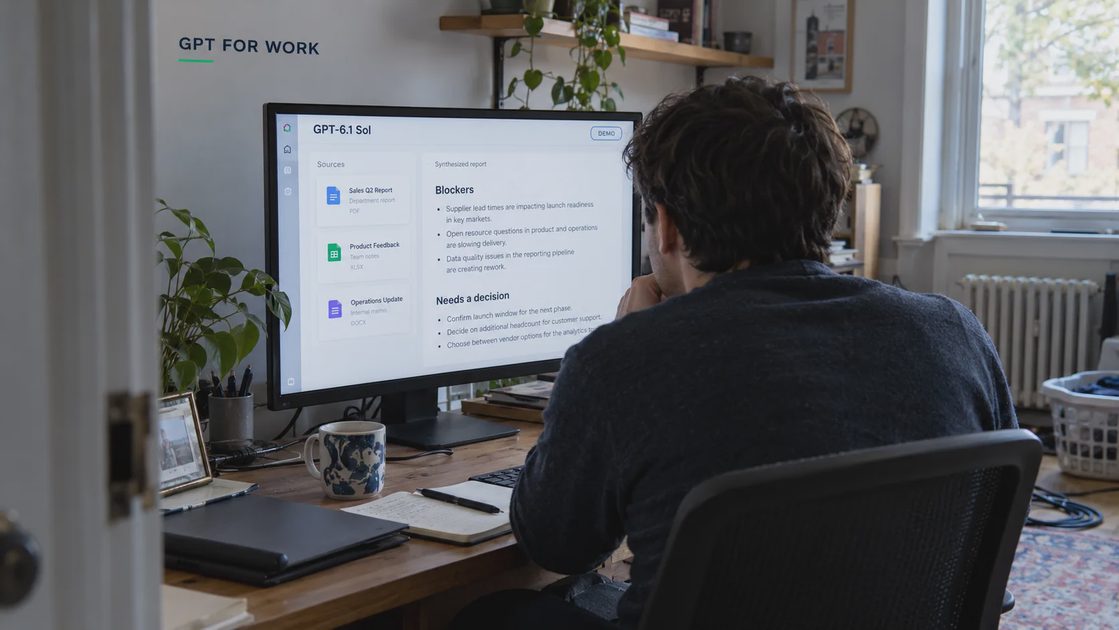
My starting point for using GPT-6 for work is to match the model to a specific task and check the result against the original material. I would begin with GPT-6.1 Sol for a mixed departmental report, use GPT-6 Luna for narrow extraction, and consider GPT-6 Astra when conflicting documents need closer analysis. Useful by Friday exists to explain those choices through ordinary work, including the parts that still need a person.
The question behind this blog is whether AI leaves less work after the checking is finished. A polished draft can help. It can also hide the exact mistake that makes it unusable. The accompanying images are editorial illustrations, not records of these experiences.
Three departments, one report, and too much noise
I had weekly reports from three departments that were difficult in opposite ways. Some buried useful information beneath routine activity. Others were so compressed that their abbreviations meant little outside the team that wrote them.
Asking AI to shorten everything missed the real problem. I needed a standard for what management should see: unusual metrics, blockers, and decisions requiring attention. Once that standard guided the extraction, compilation time fell by more than half, by my rough recollection rather than a timed comparison.
Another reporting attempt exposed a different problem. A warehouse update about switching to cheaper packing tape became grand language about supply-chain resilience and cost effectiveness. The wording suggested value the source had never established.
That is why my interest in GPT-6 productivity starts with the reader's decision. I want a report that preserves what matters and stays within the evidence. Better prose should not make a small operational change sound more consequential than it was.
Those earlier experiences inform this blog; their model versions were not recorded. The GPT-6 model choices below are my recommendations for handling those tasks now, rather than claims about which model produced the original results.
Which GPT-6 model I would use for each job
For a practical starting point, OpenAI positions GPT-6 Luna for focused, high-volume tasks, GPT-6.1 Sol for complex professional work at a lower cost than Astra, and GPT-6 Astra for demanding work; translating those descriptions into the assignments below is my editorial judgment, not a benchmark result.
Task from my experience | My starting model | What I would check |
|---|---|---|
Combine three departments' weekly updates | GPT-6.1 Sol | Important exceptions survive; routine activity does not become invented strategic value. |
Extract dates and requests from customer emails | GPT-6 Luna | Each item appears in the source; disputed facts remain disputed. |
Draft a customer reply within company policy | GPT-6.1 Sol | No unsupported admission, refund promise, or delivery commitment. |
Translate messy warehouse exports into cleaning logic | GPT-6.1 Sol with executable code or formulas | Row counts, identifiers, amounts, and exceptions survive the conversion. |
Identify contradictory approval rules in an old procedure | GPT-6 Astra | Both passages are shown; the model does not decide which policy has authority. |
The procedure example involved a 30-page document revised over four years, with conflicting approval rules. I asked AI to find the contradictions before attempting a rewrite. That distinction is why I would consider Astra for the review now: I want paired passages and a clear account of the conflict, leaving the policy decision with its owner.
For extraction that requires interpreting complicated policy or disputed correspondence, I would move from Luna to Sol and retain the same checks. A more capable model does not remove the need to define the task.
The dates matter, too. OpenAI's official pages identify Astra's announcement as September 3, 2026, Sol and Luna's as September 22, and the subsequent GPT-6.1 Sol update as September 29. Those milestones do not establish when every account received access. Official announcement dates and updates. September 29 update.
For the Sol workflow, I mean ChatGPT Work or an appropriately configured API environment, not an assumption that the same model is available in every ordinary Chat conversation. I would confirm the model and enabled tools before following any tutorial here.
A convincing table still needs checking
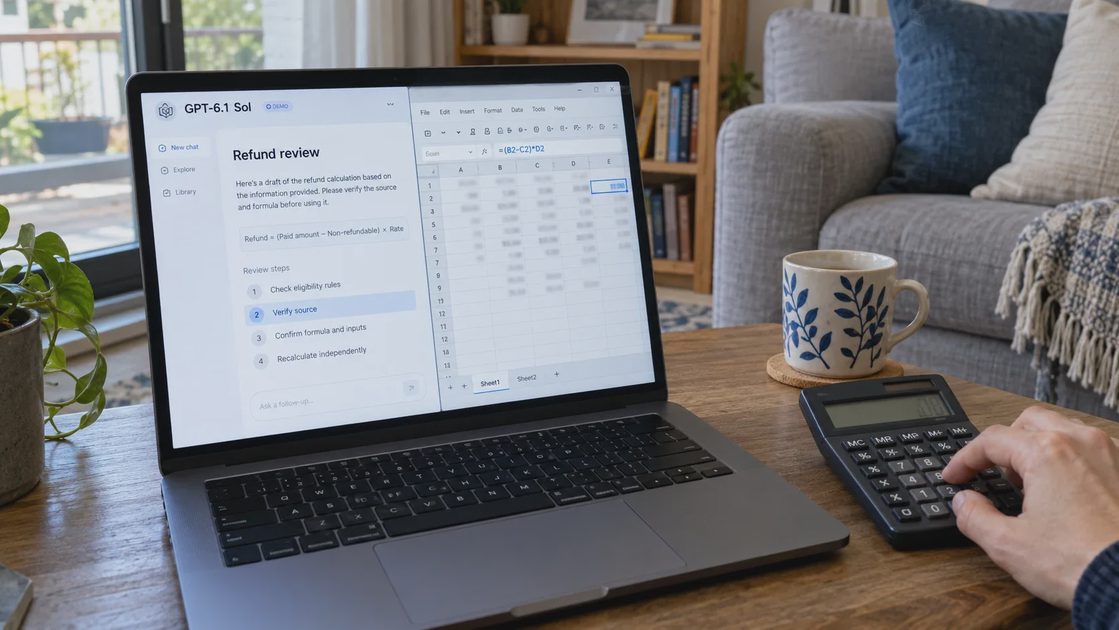
A refund task gave me a useful reason to distrust neat formatting. The source described the amount remaining after an earlier allowance had been deducted. The AI added the amounts instead and proposed an excessive refund in an otherwise convincing table.
My correction is to separate interpretation from execution. With GPT-6.1 Sol, I would ask for the input amounts, the meaning of each amount, and an explicit formula, then execute that formula in a spreadsheet or code environment. I would check the formula against the original wording before approving anything.
This leaves room for AI to help with calculations while keeping the operation inspectable. Running arithmetic correctly cannot rescue a mistaken interpretation of what should be subtracted.
A logistics-delay example produced another complete-looking mistake. Responsibility was ambiguous, but the AI assigned it to the warehouse while overlooking a qualification in the driver's notes.
For that job, I would use Sol to organize the evidence and require “pending human verification” wherever responsibility remained unclear. Astra could help examine a difficult conflict, but I would not give it authority to settle the dispute. An unresolved answer with an explanation is more useful than a confident accusation without support.
What my GPT-6 prompts need to preserve
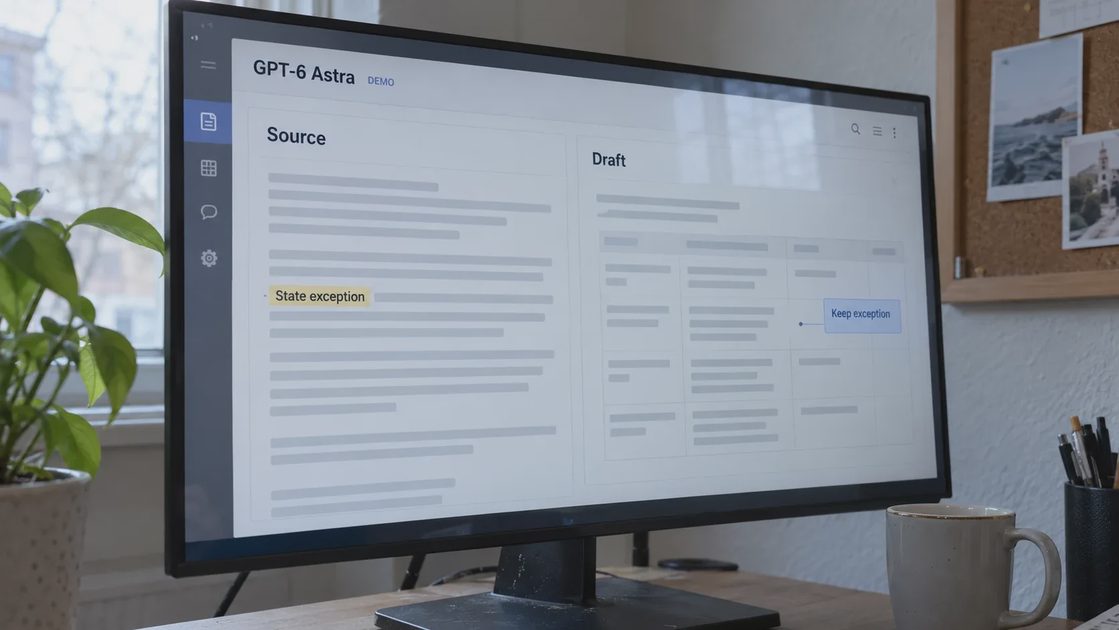
The most useful instruction often identifies what must remain unchanged. In one formatting task, AI removed parenthetical exceptions that applied only in particular states. The shorter table looked cleaner while losing conditions that affected how it could be used.
For a similar conversion, I would explicitly require every exception to remain attached to its relevant rule. Then I would compare the transformed version with the source. I would treat any legal interpretation as a separate review task for the responsible person.
Here is a starting instruction I would adapt, rather than a claim that I tested this exact wording:
Use only the supplied material. Preserve exceptions, disputed statements, and unresolved ownership. Separate source facts from proposed actions. Mark missing information instead of filling it in. Return the draft and the items I need to verify.
When I share ChatGPT prompts for work, I want the surrounding checks to be as clear as the instructions. These workflow examples share a practical constraint: the next reader needs to understand what is established and what remains open. That matters more to me than finding a clever phrase for every prompt.
What you can expect from Useful by Friday
If you are learning how to use GPT-6, I want this site to make the setup, model choice, and remaining work visible. Someone exploring ChatGPT for work should be able to follow the reasoning without knowing how to build an automation system.
The Monday Test will cover emails, reports, meetings, and weekly planning. Prompt Repair Shop will explain how changes to context and constraints affect a result. The Failure Log will examine errors such as invented responsibility and missing exceptions. Workflows That Stick will focus on reusable instructions and understandable handoffs.
Life Outside the Spreadsheet leaves room for smaller projects. At home, I have used AI to cut unnecessary equipment from a family camping list. With an old coffee maker, I replaced an unhelpful photo-based suggestion with observations about sounds and water flow. For planning around weather, facilities, and space, I would start with Sol. Appliance troubleshooting would need the manual and verified observations before I chose a model; choosing Astra would not make uncertain repair advice safe. For a child’s question-led learning exercise, I would try Luna with a clear instruction to ask rather than supply the answer. These are starting choices, not measured results.
Start with one result you can verify
I would skip AI when a short email is already easy to write, or when preparing and reviewing the output takes longer than doing the task directly. I would also stop if the workflow required material I was not permitted to share.
For your first attempt, choose a small, reversible task using nonsensitive material. Finish this sentence before running it: “I need ___, and the result must preserve ___.”
Use the model table as a starting hypothesis, then compare the output with the source. Keep the workflow only if the whole process, including corrections, helps. That is the kind of progress I want Useful by Friday to document.
No letters yet — be the first to write.